
 All vikis
 Aion 2
 Ananta
 ArcheAge Chronicles
 Call of Duty: Modern Warfare 4
 Chrono Odyssey
 Civilization 3
 Civilization 4
 Crimson Desert
 Deadlock
 Diablo 4
 Diablo 5
 Enshrouded
 Fable
 Final Fantasy Resonance
 Grand Theft Auto 6
 Heroes of Might and Magic 3
 Heroes of Might and Magic: Olden Era
 Kingdom Come: Deliverance 2
 Path of Exile 2
 Phantom Blade Zero
 Soulframe
 Valheim
 Witcher 3: Wild Hunt – Remastered
Beginner's Guide
A Slay the Spire 2 run is a climb through three acts of card battles, each ending in a boss; beginners do best by taking only cards that help, removing Strikes and Defends, blocking big attacks, finding damage that scales, fighting a few Elites near rest sites and using potions freely. Start with the Ironclad, the only character unlocked at first.
In Slay the Spire 2 you climb a three-act Spire one room at a time, fighting with a deck of cards that grows as you go, and a run ends when you beat the third act's boss or your HP reaches 0. The beginner guides agree on a short list of habits that win more runs: take only the cards your deck needs, remove weak starter cards, Block big attacks, find damage that keeps growing, fight a few Elites, and spend potions instead of hoarding them. Losing is normal: Mega Crit counted a 16% win rate at the base difficulty (May 23, 2026). The game is in Early Access, so cards and numbers still change between patches. Each tip below is credited to the guide that gives it.
Quick facts
| First character | The Ironclad (80 HP), the only one unlocked at the start |
| Start of every run | 99 Gold, 3 Energy a turn (Spire Codex, game data, v0.107.1) |
| Ironclad's starting deck | 5 Strike, 4 Defend, 1 Bash (same source) |
| Potion slots | 3 (Mobalytics) |
| Acts | 3: the Overgrowth or the Underdocks, then the Hive, then Glory |
| Run length | About 45 to 50 encounters, up to about 40 minutes (Game Rant, Mar 12, 2026) |
| Win rate at Ascension 0 | 16% (Mega Crit, May 23, 2026) |
How a run works
Every run follows the same shape. You choose a character, take one blessing from the Ancient Neow, then pick a route up a branching map of fights, Elites, ? rooms, Merchants, treasure chests and rest sites, with a boss at the top of each act. Act 1 is either the Overgrowth or the Underdocks, Act 2 the Hive and Act 3 Glory. Each fight is turn-based: you draw a hand, spend Energy on cards, and see each enemy's intent (what it will do next) above its head. Game Rant (Mar 12, 2026) counts about 45 to 50 encounters before the final boss and says a run lasts up to about 40 minutes. The map is on Acts and the Map.
Winning a fight gives Gold, a card reward you may skip, and a chance at a potion; Elites also give a relic, a permanent passive item (Game Rant). Whether you win or lose, the run unlocks content on the Timeline, including the next character.
Which character to start with
You start with the Ironclad, because he is the only character unlocked. Each later character unlocks after one run with the one before it, win or lose: the Silent, then the Regent, the Necrobinder and the Defect (TheGamer, Mar 6, 2026). The Ironclad starts with 80 HP and Burning Blood, which heals 6 HP after each combat (Game Rant, Mar 7, 2026).
The guides disagree on the easiest character. Game Rant (Mar 10, 2026) and TheGamer (Mar 9, 2026) name the Ironclad, for his Block cards and healing, and TheGamer suggests learning the Regent before the Defect because Stars are simpler than Orbs. Kotaku's Lewis Parker (Mar 18, 2026) calls the Necrobinder the easiest, followed by the Silent, and PC Gamer's Evan Lahti calls storing Block on her companion Osty "defensive scaling that makes Necrobinder a particularly new-player-friendly character" (PC Gamer, Sep 18, 2026). Game Rant and TheGamer rate the Regent and the Defect hardest, since both manage a second resource. Every character is on Characters.
Block first, then attack
Read the intents and Block when an enemy is about to attack. Game Rant's tips say to Block first when enemies intend to attack and spend leftover Energy on attacks, and to attack freely on turns when enemies buff or shield themselves. Game Rant also says to weigh taking a hit against how far away the next rest site is.
Expect enemies to hit harder than in the first game. Kotaku's Parker cites an Act 1 eel hitting for 36 and says a starter deck often blocks only about 15 against 24-damage attacks, so early Block cards with high numbers are worth taking.
Take fewer cards
Skip card rewards that do not help. Mobalytics' beginner guide (updated Mar 19, 2026) says not to take every card, because a smaller, focused deck is stronger: you draw your best cards more often. The first cards to look for are damage cards. Mobalytics warns "A bunch of Strikes is not gonna cut it on the Elites or Boss!", and Jorbs suggests in his Untapped.gg guide (Mar 2026) adding two or three frontloaded damage cards at the start of each run.
Guides differ on when to commit to a plan. Kotaku says not to commit in Act 1: take cards that help now (AoE attacks, high-Block skills) and pivot to a build near the end of Act 1 or the start of Act 2. TheGamer says to commit to an archetype from your early picks, since a Common that fits can beat an off-plan Rare. Game Rant suggests staying flexible unless an early relic points the way. More on Deck-Building Strategy.
Remove Strikes and Defends
Pay to remove weak starter cards. Game Rant says each character starts with up to five Strikes and five Defends, and to remove them at the Merchant (one removal per visit) or at events once you have better cards. Mobalytics calls removing Strikes and Defends at the shop "often the best way to spend your money." Kotaku adds a caveat: thinning helps less than in the first game, because Elites and bosses add Status cards to your deck.
Find scaling
Your deck needs damage or defense that grows during a fight. Mobalytics says enemies often buff their Strength every 3 or 4 turns, so a deck needs scaling such as Demon Form, Poison or Doom, Block over time, or powers like Defragment or Genesis. It calls turtling a bad long-term plan because most fights scale, and says to carry both AoE and single-target damage.
Card draw is strong. Mobalytics calls draw "OP" and says a card that draws for zero Energy, such as Offering or Prepared, is usually very good, as long as draw and Energy stay in balance.
Fight some Elites
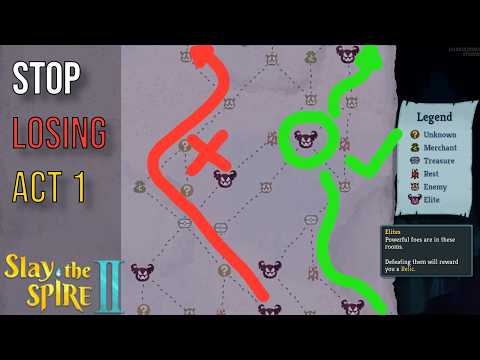
Elites are dangerous, but their relics win runs. Mobalytics says to learn to take "a few each act." TheGamer aims for at least one Elite per act with two as the ideal, and says to fight them near rest sites. Game Rant says an Elite gives a card, a random potion and a relic but can end a run, and that with plenty of Gold the Merchant is the safer choice. The Elite fights are on Elites.
Warm up before the first Elite. Mobalytics says to fight several normal enemies early in Act 1 for Gold and card rewards before you take on Elites. Since Mega Crit's v0.101.0 (Mar 27, 2026), on the main branch since Apr 17, 2026, Elites no longer appear on floor 6, so the first few floors are normal fights, events and shops. Routes are on Pathing Guide.
Look at the map before Neow
Choose Neow's blessing with the map open. Game Rant says the map is always available from the icon at the top right, even during dialogue: a big Gold reward suits a route with an early Merchant, and a max HP loss suits a route with fewer Elites. You can also see each act's boss on the map, which PC Gamer's Abigail Shannon (Mar 13, 2026) says to check at the start so you can prepare the deck.
Rest or Smith
At a rest site you either Rest to heal or Smith to upgrade a card, and the guides weigh it differently. Mobalytics says "Resting is bait": HP is a resource, and every heal costs an upgrade unless you own Miniature Tent. GamesRadar+'s Austin Wood says on PC Gamer's panel that the easiest way to clear Act 1 reliably is to rest at every opportunity. More on Merchant and Rest Sites.
Shop well
Know what the Merchant sells. Game Rant lists 5 character cards, 2 Colorless cards, 3 relics, 3 potions and a card removal. Since Major Update #1 (Apr 17, 2026), shop relics cost 25 Gold less than at launch.
Use your potions
Drink potions when a fight is going badly, not only at bosses. TheGamer says you get a chance at a free potion after each fight, so use them when struggling rather than hoard them. Mobalytics says you have 3 potion slots, so use a potion whenever they are full rather than waste the next drop. Every potion is on Potions.
Learn from losses
Expect to lose early runs. TheGamer says early losses are normal while Epoch unlocks fill out each character's card pool, and Kotaku recommends working through Epochs such as "Kill 15 Bosses" and "Kill 15 Elites" before starting Ascension. Jorbs' first guideline in his Untapped.gg starter guide (Mar 2026) is "There are no bad cards, only bad situations," and he says every loss teaches something.
Watch good players. Kotaku names Mobalytics' card tier list and Northernlion's Slay the Spire 2 videos as resources for beginners, and Baalorlord, Frost Prime and Jorbs as experts. Card rankings are on Card Tier List.
Frequently asked questions
What is the best character for beginners in Slay the Spire 2? Game Rant and TheGamer recommend the Ironclad for beginners in Slay the Spire 2, for his 80 HP, healing and Block cards; Kotaku and PC Gamer's Evan Lahti name the Necrobinder instead. The Ironclad is the only character unlocked at the start.
How do you unlock characters in Slay the Spire 2? In Slay the Spire 2 each character unlocks after one run with the one before it, win or lose: the Ironclad, then the Silent, the Regent, the Necrobinder and the Defect (TheGamer, Mar 6, 2026).
Should you take every card in Slay the Spire 2? No. Mobalytics' beginner guide says a smaller, focused deck is stronger in Slay the Spire 2, and that removing Strikes and Defends at the shop is "often the best way to spend your money."
How many Elites should you fight in Slay the Spire 2? TheGamer says at least one Elite per act in Slay the Spire 2, two ideally, fought near rest sites; Mobalytics says "a few each act." Both say Elites' relics are worth the risk.
Should you rest or upgrade in Slay the Spire 2? Guides differ: Mobalytics calls resting "bait" because each heal costs an upgrade, while GamesRadar+'s Austin Wood rests at every chance in Act 1.
How long is a run in Slay the Spire 2? A Slay the Spire 2 run has about 45 to 50 encounters and takes up to about 40 minutes, sometimes an hour or more, per Game Rant (Mar 12, 2026).
Is Slay the Spire 2 hard for beginners? Yes, at first: Mega Crit counted a 16% win rate at Ascension 0 in its May 2026 Neowsletter, against 9% in the first game, and Kotaku calls Act 1 possibly the hardest act in the series.
Sources
- Slay the Spire 2: Essential Tips & Tricks for Beginners, Game Rant (Matt Vatankhah), Mar 7, 2026
- The Hardest Playable Characters In Slay The Spire 2, Ranked, Game Rant (Marc Santos), Mar 10, 2026
- All Acts, Biomes, and Bosses in Slay the Spire 2, Game Rant (Marc Santos), Mar 12, 2026
- Slay the Spire 2 Ultimate Beginner Guide, Mobalytics, updated Mar 19, 2026
- A Slay The Spire 2 Guide For Getting Better And Surviving Your First Full Run, Kotaku (Lewis Parker), Mar 18, 2026
- 8 Beginner Tips And Tricks For Slay The Spire 2, TheGamer (Collin MacGregor), Mar 9, 2026
- How To Unlock Every Character In Slay The Spire 2, TheGamer (Jacob Whaling), Mar 6, 2026
- After 894 hours in Slay the Spire 2, these are our 12 strongest opinions, PC Gamer (Evan Lahti, Harvey Randall, Austin Wood), Sep 18, 2026
- Vantom boss guide for Slay the Spire 2, PC Gamer (Abigail Shannon), Mar 13, 2026
- Slay the Spire Deckbuilding Strategy: Solving the Spire with "Jobs", Untapped.gg (Jorbs), Mar 2026
- My Guidelines For Starting Slay the Spire 2, Untapped.gg (Jorbs), Mar 2026
- Beta Patch Notes - v0.101.0, Mega Crit (Anthony Giovannetti), Mar 27, 2026
- Major Update #1 - v0.103.2, Mega Crit, Apr 17, 2026
- The Neowsletter - May 2026, Mega Crit (Demi Montes), May 23, 2026
- Slay the Spire 2 characters, Spire Codex (game data, v0.107.1), read Oct 26, 2026
- Slay the Spire 2 Beginner’s Guide | Important Tips You Need to Know, IGN, Mar 16, 2026 (video)
- Slay the Spire 2 - Official Gameplay Trailer, Mega Crit, Dec 13, 2024 (video)
- 10 Things That Instantly Improved My Runs | Slay the Spire 2 Tips & Guide, Nerdy Hickey, Apr 7, 2026 (video)
Moments
Slay the Spire 2 Beginner’s Guide | Important Tips You Need to Know
IGN
- In Slay the Spire 2 you climb a three-act Spire one room at a time, fighting with a deck of cards that grows as you…
- You start with the Ironclad, because he is the only character unlocked. Each later character unlocks after one run…
- Read the intents and Block when an enemy is about to attack. Game Rant's tips say to Block first when enemies intend…
- Expect to lose early runs. TheGamer says early losses are normal while Epoch unlocks fill out each character's card…
Slay the Spire 2 - Official Gameplay Trailer
Mega Crit
10 Things That Instantly Improved My Runs | Slay the Spire 2 Tips & Guide
Nerdy Hickey
- Skip card rewards that do not help. Mobalytics' beginner guide (updated Mar 19, 2026) says not to take every card…
- Elites are dangerous, but their relics win runs. Mobalytics says to learn to take "a few each act." TheGamer aims for…
- Choose Neow's blessing with the map open. Game Rant says the map is always available from the icon at the top right…
- Drink potions when a fight is going badly, not only at bosses. TheGamer says you get a chance at a free potion after…
Related
-
 Ascension GuideTo climb Slay the Spire 2's Ascension ladder, the guides say to fix your starter deck's weaknesses fast (damage and AoE first, then Block, draw and scaling), survive an Act 1 with more Elites by resting and using potions, and prepare for Ascension 10's two Act 3 bosses. About 17% of Ascension 10 runs were wins in May 2026, per Mega Crit.
-
 Card Tier ListThere is no single Slay the Spire 2 tier list: PCGamesN (Apr 28, 2026) and Pocket Tactics (Oct 5, 2026) both rank the Silent best, but they disagree on the Ironclad and Necrobinder, and PCGamesN's (Apr 2026) and Mobalytics' (Aug 12, 2026) card lists put cards such as Body Slam, Demon Form and Graveblast at opposite ends.
-
 Co-op StrategyIn Slay the Spire 2 co-op, enemies scale with party size and attack everyone, so the guides advise one player leaning into support (Weak, Vulnerable, team Block), timing attacks after an ally's debuffs, taking multiplayer cards such as Knockdown, Flanking and Rally, and talking through relics and rest-site healing. Mobalytics' multiplayer tier list puts Knockdown, Flanking, Beacon of Hope, Rally, Glimpse Beyond, Energy Surge and Huddle Up in S tier.
-
 Deck-Building StrategyGood Slay the Spire 2 decks cover a few jobs in order (front-loaded damage and AoE, then Block, then card draw and Energy, then scaling), skip cards that do not help, and follow relics and enchantments rather than forcing one archetype. Infinite combos still exist, but Mega Crit's v0.100.0 balance pass (Mar 20, 2026) aimed to make them harder to reach.
-
 Defect GuideThe Defect is the last Slay the Spire 2 character to unlock, with 75 HP, 3 Orb slots and Cracked Core (Channel 1 Lightning at the start of each combat). Guides build it around Orbs and Focus, with Defragment as the key Power, and treat Claw and Status decks as weaker at high Ascension; both tier lists rank it A.
-
 Ironclad GuideThe Ironclad is Slay the Spire 2's starting character, with 80 HP and Burning Blood (heal 6 HP after each combat). Guides build him around Vulnerable, Body Slam Block, Exhaust or Strength, and agree on taking early damage and energy cards such as Bloodletting, Pommel Strike and Offering.
-
 Necrobinder GuideThe Necrobinder is one of Slay the Spire 2's two new characters, with 66 HP, the lowest of the five, and Bound Phylactery (Summon 1 at the start of your turn). Guides build her around Osty, her giant hand that soaks damage, Souls for card draw, or Doom, and disagree on whether she is the easiest character or a weak one.
-
Pathing GuideIn Slay the Spire 2, plan your route before choosing Neow's blessing, fight a few normal enemies before the first Elite, take one or two Elites per act near rest sites (guides differ on how many), and use ? rooms, shops and rest sites to match your deck's health. Check each act's boss on the map and pick Ancient blessings that fix your deck's weakest point.
See also
-
-
 OvergrowthThe Overgrowth is one of the two possible first acts of Slay the Spire 2, a jungle ruin chosen by a coin flip against the Underdocks, with the Elites Bygone Effigy, Byrdonis and Phrog Parasite and the bosses Ceremonial Beast, The Kin and Vantom.
-
UnderdocksThe Underdocks is the alternate first act of Slay the Spire 2, a sewer waterway chosen by a coin flip against the Overgrowth once unlocked, with the Elites Phantasmal Gardener, Skulking Colony and Terror Eel and the bosses Lagavulin Matriarch, Soul Fysh and Waterfall Giant.
-
 HiveThe Hive is Act 2 of every Slay the Spire 2 run, an insect nest whose Elites are the Decimillipede, Entomancer and Infested Prism and whose boss is the Kaiser Crab, the Knowledge Demon or The Insatiable; an Ancient greets you at its start.
-
GloryGlory is Act 3 of Slay the Spire 2, the upper Spire, whose Elites are the Knight Trio, the Mecha Knight and the Soul Nexus and whose boss is Aeonglass, the Queen or the Test Subject; at Ascension 10 you fight two of them.
-
 Acts and the MapA Slay the Spire 2 run climbs three acts, the Overgrowth or the Underdocks (a coin flip), then the Hive, then Glory, each opening with an Ancient and ending in a boss, before the Architect ends the climb. Each act is a branching map of combat, Elite, ? (Unknown), Merchant, Treasure and Rest Site rooms; Game Rant puts a run at about 45 to 50 encounters and up to about 40 minutes.